

Romain Gandia, IAE Savoie Mont Blanc and Guy Parmentier, Grenoble IAE Graduate School of Management
The regional press is suffering the consequences of the COVID-19 crisis. Already weakened for many years by the decline of its traditional business model, the reduction in distribution following Presstalis’ bankruptcy and the decline in advertising revenue now threaten to prove fatal.
As a result, the daily newspaper *Paris-Normandie* was placed in court-ordered liquidation on April 21 after accumulating 7 million euros in debt. This is far from an isolated case, and many other publications are facing financial difficulties.
Digitalization has its limits
This situation is nothing new, and the diagnosis is well known: a decline in print readership, a decline in distribution outlets, a decline in advertising revenue, and newspaper prices rising faster than inflation.
The business model, which relies primarily on revenue from advertising and subscription sales, is being challenged by the rise of free access to information and the fragmentation of online behavior.
The regional press is therefore struggling to find a new business model in the digital age of news, even though it plays a central role in upholding democracy. According to Clara Hendrickson, a researcher at the Brookings Institution, the crisis facing the local press may even be one of the causes of the crisis in American democracy.
The regional press has tried to replicate its business model by moving it online: a partially free online newspaper, subscriptions to the digital version, online advertising, and targeted content purchases. However, digital advertising is not profitable enough, and online access to information remains difficult to monetize due to internet users’ low willingness to pay.
It is therefore necessary to attract a large number of internet users and achieve a high enough conversion rate from the free offering to the paid offering to offset the cost of the free offering. As a result, economic activity in the digital world takes on complex forms with unique business models, and simply replicating a physical consumption model in the digital realm is not enough. Some iconic players in the digital economy have understood this well (such as Amazon, Airbnb, eBay, Google, and Facebook), and economic equilibrium is often achieved by developing several complementary activities that create synergies.
To better understand this logic, examining the business model portfolios of tech giants Apple, Google, and Microsoft proves to be very useful and, above all, highly instructive for considering the survival of the regional press.
Creating Synergies Through Diversification
Using historical data, we analyzed the portfolio of business models of these three companies and identified the principles underlying their profitability.
The three tech giants have developed a portfolio architecture based on similar business models: at the center is a multifaceted business model involving the sale of content, digital services, and digital advertising, and on the periphery are business models centered on the sale of digital devices (computers, smartphones, tablets, connected devices, etc.). All of this is connected by a business model involving the free provision or sale of operating systems.
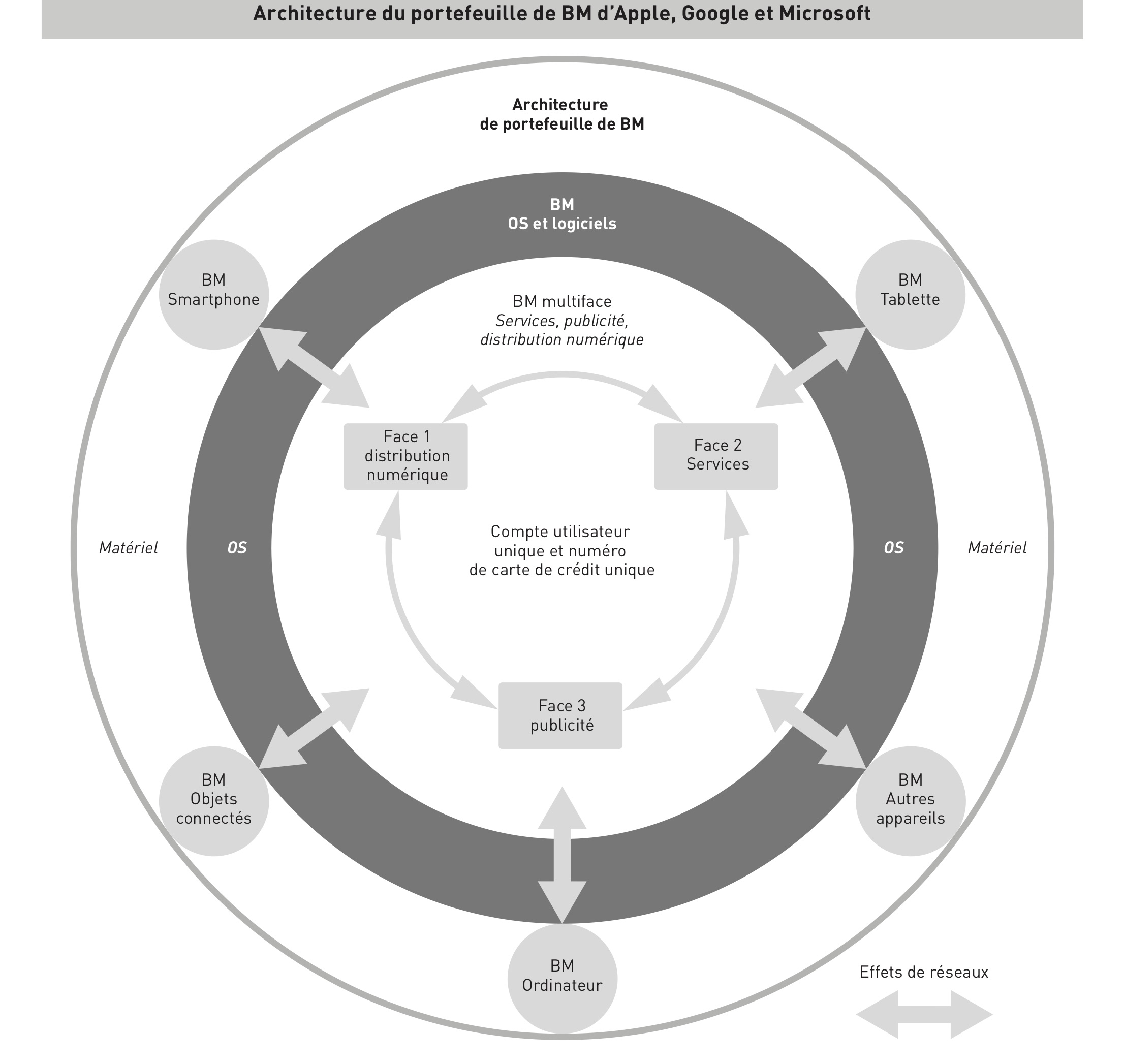
Let’s take Apple as an example. The company has developed a complex portfolio in which its iTunes Store and App Store platforms are accessible via iPhones and iPads running its iOS operating system. By linking its business models for selling digital content with those for selling high-end digital devices, Apple captures and generates high revenues.
In this type of portfolio, the connections between business models give rise to multiple positive effects: network effects, adoption effects, economies of scope, and economies of scale. All of this ensures the acquisition of a large number of users and a wide variety of revenue streams. Over time, these platforms become indispensable and play a dominant role in society.
Transforming the regional press into a platform
The regional press industry is based on local news, which generates revenue primarily through advertising. However, for companies in this sector, simply replicating their physical business model in the digital realm is not enough to ensure their profitability.
To survive in the digital world, regional media companies must consider building platforms that will enable them to diversify their offerings around their core business, thereby achieving significant cost savings.
Adopting a platform-based approach would allow the local press to distribute not only news but also a variety of complementary content (classified ads, photos and videos across multiple platforms, cultural magazines, local guides, blogs, etc.) that would enrich the overall offering by providing more value than news alone.
The more high-quality information and content with a truly local focus is shared, the more internet users there will be, thereby attracting advertisers.
Bringing together and connecting a variety of content producers and consumers would be powerful drivers for creating positive network effects.
For example, advertisers seeking to deliver the most targeted advertising possible could post their ads directly online by accessing a database of qualified internet users. Internet users looking for valuable information could access it through journalists and reporters, as well as through bloggers seeking a wider audience than a single, often obscure blog.
Through the platform, the distribution of a variety of local content in multiple formats could eventually create a mass effect and encourage wider adoption. Indeed, by engaging with a platform that offers a suite of services related to local news, internet users would have more sources of satisfaction and would be less tempted to engage with other platforms. This adoption effect would also be reinforced if a mobile app for the platform were developed, thereby promoting apush-based news model rather than a pull-based one.
Competition That Remains Unfair
However, establishing such platforms would require media consolidation at the regional level. The media company must establish or acquire other media outlets, which requires substantial resources.
Furthermore, tech giants have been trying for many years to monopolize local news. This presents a technological, economic, and societal challenge: to disrupt a system that favors large corporations at the expense of local players.
Such a revolution, therefore, cannot take place without public support, whether at the national or regional level. Nor can it happen without strong government regulation of the activities of digital giants. But it is still possible, provided we consider less static business models based on multifaceted platforms and broader portfolios of interconnected business models.
These new approaches must capitalize on scale effects, network effects, and adoption effects, which are now at the heart of the digital economy and have become key to economic success and strategic survival.
This article drew on the model developed in the paper published in *Management International*: “The Strategic Management of a Portfolio of Connected Business Models: An Application to the Digital Sectors”, which stems from research conducted as part of the ANR Better Business Model.

Romain Gandia, Associate Professor of Organizational Studies and Business Administration at the University of Savoie Mont Blanc, IAE Savoie Mont Blanc and Guy Parmentier, Associate Professor (HDR) at Grenoble IAE, Grenoble IAE Graduate School of Management
This article is republished from The Conversation under a Creative Commons license. Read the original article.