
- Share
- Partager sur Facebook
- Partager sur LinkedIn
CDP Contract

Toward automotive electronic systems that are more environmentally friendly, reliable, and offer high added value
Managing the end-of-life of automotive electronic systems has become a major challenge, at the intersection of reducing environmental impacts, industrial innovation, and strategic autonomy. While the mechanical reuse rate for end-of-life vehicles exceeds 80%, less than 5% of onboard electronic systems (ABS, GPS, cameras, ADAS, control units, sensors, etc.) are currently reused or remanufactured.
The REBOOT project aims to bridge this gap by changing the way we view these systems: rather than treating them as waste to be recycled, it regards them as technological resources to be recovered, refurbished, and reused within a circular economy framework. The project is organized around three main areas:
- Identify the flows of reusable electronic systems,
- Develop appropriate processes for recovery, reconditioning, and requalification,
- Create synergies among industry stakeholders
All of this is achieved by bringing together research and industry (Renault, The Remakers, STMicroelectronics, GPA Valence, etc.).
REBOOT, a project led by Blandine AGERON (CERAG), brings together teams specializing in electronics reliability, materials characterization, embedded systems, computer science, as well as the humanities, social sciences, and law. With a budget of €1.2 million, the project funds, among other things, four doctoral dissertations, postdoctoral positions, and an engineering position. Involving UGA, CEA LETI, INRIA, and the CNRS, it is structured into four work packages (WPs).
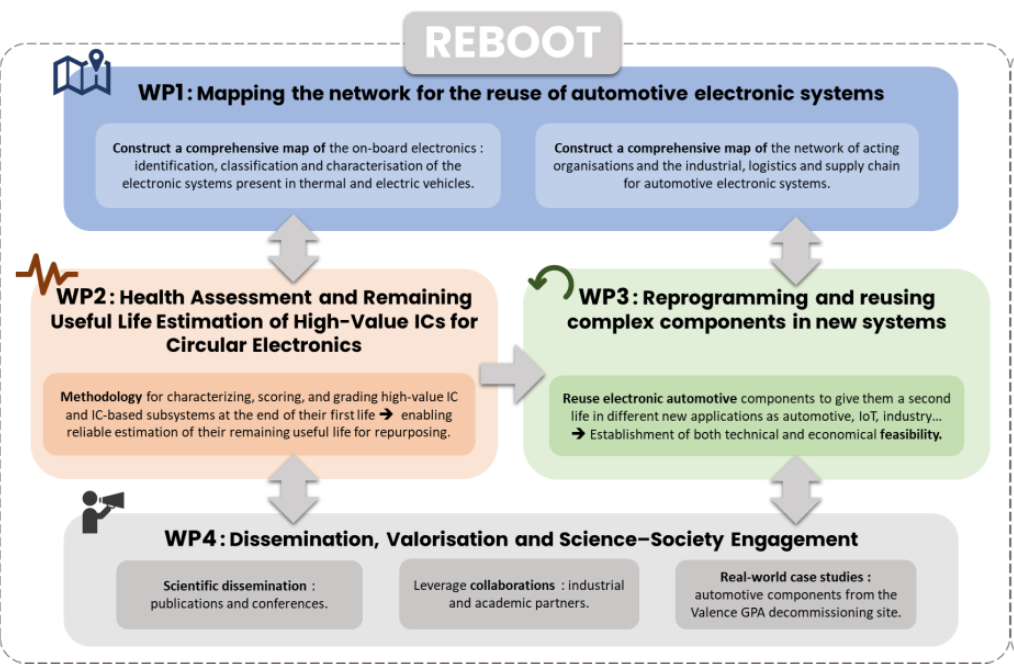
CERAG is leading WP1: “Mapping the Automotive Electronic Systems Reuse Network: Components, Stakeholders, and the Economic and Legal Environment,” under the directionof Olivier Lavastre. This work package aims to map the value chain, identify components with high reuse potential, and characterize the economic and legal environment of the sector, while maintaining ongoing interaction with the technical work of the other work packages.
Scientific Directors
Blandine Ageron (UGA/CERAG)
Thierry Baron (UGA-CNRS/LTM)
Fanny Dufossé (INRIA/LIG)
Christelle Godin (CEA/Leti)
- Share
- Partager sur Facebook
- Partager sur LinkedIn