
Creativity is the generation of original, feasible, and useful ideas by individuals or a group of individuals. In the midst of the COVID-19 crisis, we need creative ideas more than ever to overcome the challenges we face—whether to contain the pandemic, ensure essential services, repair the damage, or rethink society after the crisis.
Research on creativity focuses on the processes and conditions that lead individuals to generate creative ideas. This ability is often considered the exclusive domain of great creators and innovators, when in fact it is intrinsic to human beings.
You only have to watch babies and children as they go about their daily explorations to see this for yourself. Education, experience, failures, and criticism gradually stifle creative potential. David Kelley, one of the founders of design thinking, argues that we are all creative and that a lack of creativity stems from a lack of creative confidence. Creativity is simply a muscle that can be strengthened and maintained through effort and experience.
Research on creativity focuses on the creative process, individual characteristics, and context.
The COVID-19 crisis is a fertile ground for creativity. It creates a sense of urgency. It motivates us and pushes us to think outside the box to respond to extraordinary circumstances. According to Harvard professor Teresa Amabile, in her component model of creativity, motivation is one of the basic elements of creativity, along with domain knowledge and creative abilities. Motivation is certainly present, and it is driven by the emotions triggered by this exceptional situation.
The work of American psychiatrist Silviano Arieti clearly demonstrates the fundamental role of emotion in creativity. The psychology of creativity identifies personality traits and cognitive styles that foster creativity (see the book Psychology of Creativity by Todd Lubart), but a sense of urgency is likely to transcend these psychological fundamentals.
An analysis of these processes can therefore provide us with resources to draw upon in order to quickly generate new ideas for addressing the emergency.
Asking the Right Questions
In the early20thcentury, the mathematician Henri Poincaré, while describing the process of discovering Fuchsian functions —which have a complex number as their variable—outlined an initial framework for the individual creative process: preparation, incubation, illumination, and verification. Preparation involves the preliminary analysis of a problem. It entails seeking out information and drawing on knowledge to identify, analyze, and precisely define the problem.
This first phase, which is part of the CPS method's clarification phase (Creative Problem Solving) methodology, is crucial. Identifying the right problem is the foundation of a creative solution.
For example, let’s say you have an interesting, well-paying job, but you can’t stand your boss anymore. The question might be: How can I find a similar job somewhere else? Reframing the problem might lead you to ask a different question: How can I get my boss to find another job? You’ll likely come up with a more creative solution—and perhaps one that’s more acceptable to you. Reframing the problem allows you to start thinking differently.
To support the medical community, the company 1083 halted production of jeans in order to dedicate its workshop to making protective masks. But how can a small workshop produce on a large scale? 1083 reframed the problem: How can we expand production capacity without additional resources? It issued a call to all seamstresses in the Drôme region to help with the production.
Thinking Outside the Box
Our thinking tends to become confined within the frameworks created by language and routines. German psychologist Karl Duncker, through his concept of functional fixity, demonstrated that we rely on mental frameworks—particularly the functions assigned to objects—to find solutions. By remaining within these mental frameworks—language, the functions of objects, our conception of the world, our view of business operations, and routines—it is difficult to come up with original ideas.
Creativity requires stepping outside these mental frameworks and thinking differently. Creative methods such as CPS and design thinking were developed to challenge conventional wisdom. Under pressure, our emotions can push us to question established frameworks, and imagination is a powerful tool for breaking free from them.
Imagination involves visualizing objects that are not present and combining images of those objects. It brings new possibilities into virtual existence. In this sense, it breaks free from established frameworks, leading us to see the world from a different perspective and to step outside the dominant logic. It allows us to mentally explore numerous possibilities in order to arrive at new ideas.
For example, thinking outside the box might mean deviating from traditional industrial processes and standardization procedures to supply hospitals with ventilators. For instance, the Polish company Urbicum developed an open-source, 3D-printable ventilator and called on doctors, anesthesiologists, and hospital technicians to help them develop the project.
Make new connections
Creative associations are at the heart of creativity. A new idea is a new combination of preexisting knowledge and ideas. The Hungarian essayist Arthur Koestler, in his book Archimedes’ Cry , identifies the mechanism of bissociation, which lies at the heart of humor, science, and art.
For him, creativity stems from a new combination of previously unrelated elements through the use of processes of comparison, abstraction, and categorization. This mechanism of association can be found in “synectics,” developed by psychologist George Prince and engineer William Gordon, a creativity method based on analogy that involves making and unmaking associations in order to break out of habitual ways of thinking.
An analogy involves taking elements from one domain and applying them to another—for example, comparing traffic flow to Internet data traffic—to see if the characteristics of traffic flow can provide insights for solving a problem related to Internet traffic management.
Neuroscience has also shown that creativity depends on the strength of the connections that form unconsciously in our brains and on the ability of a control network to bring salient ideas to consciousness based on the individual’s current concerns.
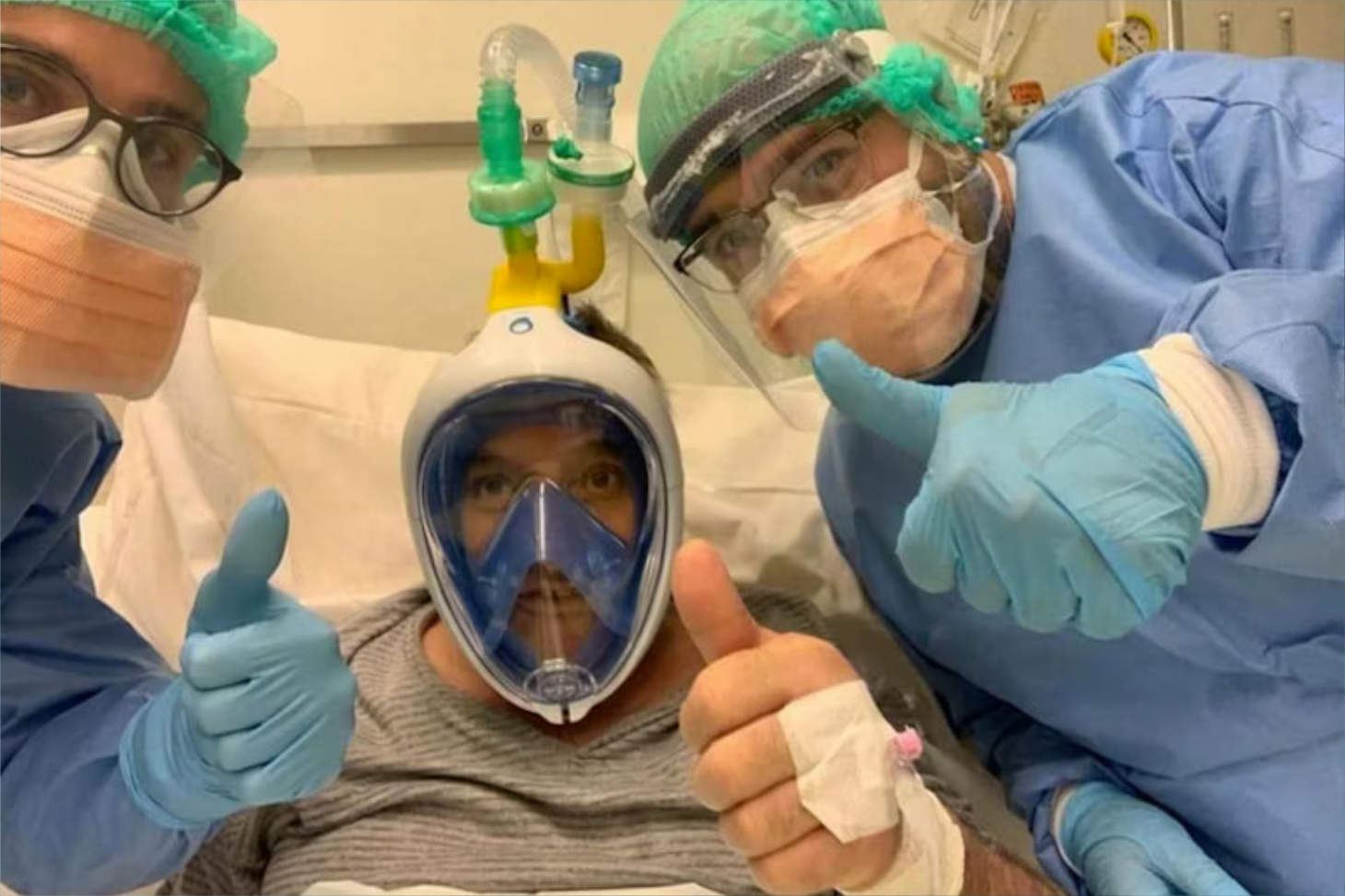
In response to the emergency in Italy, and to address the shortage of equipment in hospitals, the company Isinnova has converted Decathlon-brand diving masks into respirators. This represents a convergence between the world of diving—where the issue of breathing is central—and the field of medical respiratory support.
Sharing Ideas
Creativity depends not only on new connections between ideas and knowledge but also on connections between people. An idea that remains in a single mind is unlikely to be put to good use. The idea needs to be enriched through discussion and shared so that it can be combined with others to transform them into more fully developed ideas.
Research on brainstorming has shown that creative group work is effective under certain facilitation conditions and guidelines. Research on social networks has shown that individuals who are positioned at the intersection of different groups gather a wider variety of knowledge and ideas, and thus come up with more original ideas.
Creativity therefore depends on the networking of individuals who work together toward a common goal without being overly constrained by processes and routines imposed by institutions. The recent initiative by the city of Grenoble to bring together manufacturers and researchers to set up a temporary production line for masks and ventilator parts is a good example of this.
It is the diverse ideas of experts from different disciplines and fields, combined with the mobilization of their network, that may enable them to establish a new industrial sector in less than two weeks.
Similarly, in Paris, neighborhood groups are forming on Facebook to help one another, share ideas on how to cope with the lockdown, create activities to keep children occupied, and arrange to meet at their windows.
Asking the right questions, thinking outside the box, making new connections, and creating new networks to circulate and share ideas are just a few of the basic mechanisms of creativity—which encompasses many others. However, systematically applying these mechanisms could help us quickly come up with new ideas to combat the consequences of the COVID-19 pandemic.

Guy Parmentier, Associate Professor (HDR) at Grenoble IAE, Grenoble IAE Graduate School of Management
This article is republished from The Conversation under a Creative Commons license. Read the original article.