
- Share
- Partager sur Facebook
- Partager sur LinkedIn
Defense
13, December 2023
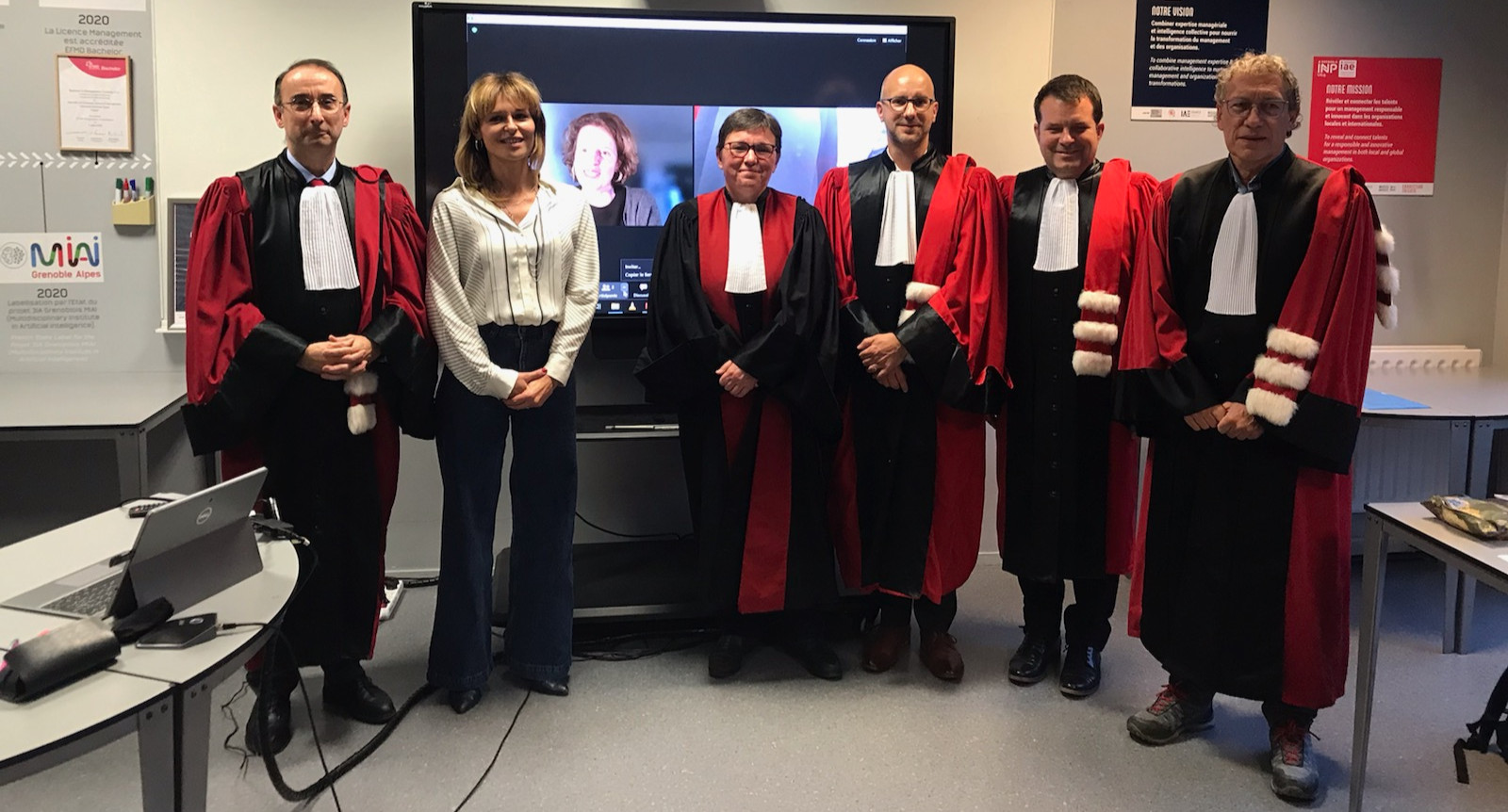
Clinical Analysis of the Role of Microelectronics Production Technicians in the Context of Industry 4.0 Automation: An Analysis by the Clinic of Work Activities and Human Resource Management Challenges
Jury Membership
| Christian DEFELIX | Université Grenoble Alpes - INP | Thesis Advisor |
| Daniel BRISSAUD | Université Grenoble Alpes - INP | Co-supervisor of thesis |
| Laurent TASKIN | Catholic University of Louvain | Examiner |
| Peggy ZWOLINSKI | Université Grenoble Alpes - INP | Examiner |
| Géraldine GALINDO | ESCP Business School | Rapporteur |
| Ewan OIRY | University of Quebec in Montreal | Rapporteur |
Abstract
To address the challenges of manufacturing efficiency and quality, the interconnection of systems generating polymorphic data in real time and remotely, which characterizes "Industry 4.0," enables the production of customized series at mass production costs. This thesis is based on the study of an industrial case: a microelectronics company operating in a complex environment balancing fluidity and security, whose pursuit of profitability leads to intensified monitoring of anomalies by crossing automation thresholds. What consequences does this Industry 4.0 automation have on human work, which only intervenes in the event of a production flow interruption? Coupled with a categorization of exploratory results using Gomez's (2013) conceptual approach to invisible labor and its threefold experience (objective, collective, and subjective), the chosen theoretical framework is that of the clinical approach to activity (Clot, 1999), and more specifically, the occupation and its four-dimensional architecture (impersonal, interpersonal, transpersonal, and personal). Through an in-depth analysis of the occupation of Production Operator Technician in a natural environment, the use of this theoretical framework illustrates a profound shift in the spatio-temporal relationship of work. Based on direct observation (observations and semi-structured interviews) and indirect observation (cross-confrontation self-reflection), this embedded research demonstrates that work is more human than anticipated and results from contrasting experiences of reality. The results of this case study partially validate existing literature but also reveal a professional practice characterized by an overemphasis on the impersonal (objective) dimension. This, coupled with the need for information, leads to an over-reliance on the interpersonal (collective) dimension. Faced with a disrupted transpersonal dimension, this difficult navigation between dimensions generates an exacerbation of the personal (subjective) dimension to absorb these tensions on the ground. This clinical analysis in management science identifies the components and factors driving the evolution of a profession in the face of Industry 4.0 automation and seeks to demonstrate the value of aligning HR strategies with the specificities of complex environments. This work addresses the current lack of prospective research and offers a discussion that outlines other research avenues for better understanding and managing the multifaceted effects of technological change.
Date
14H
Location
Didier Retour Hall - Grenoble IAE
Saint-Martin-d'Hères - University Campus
525 Central Avenue
- Share
- Partager sur Facebook
- Partager sur LinkedIn