
- Share
- Partager sur Facebook
- Partager sur LinkedIn
Defense
14, December 2023
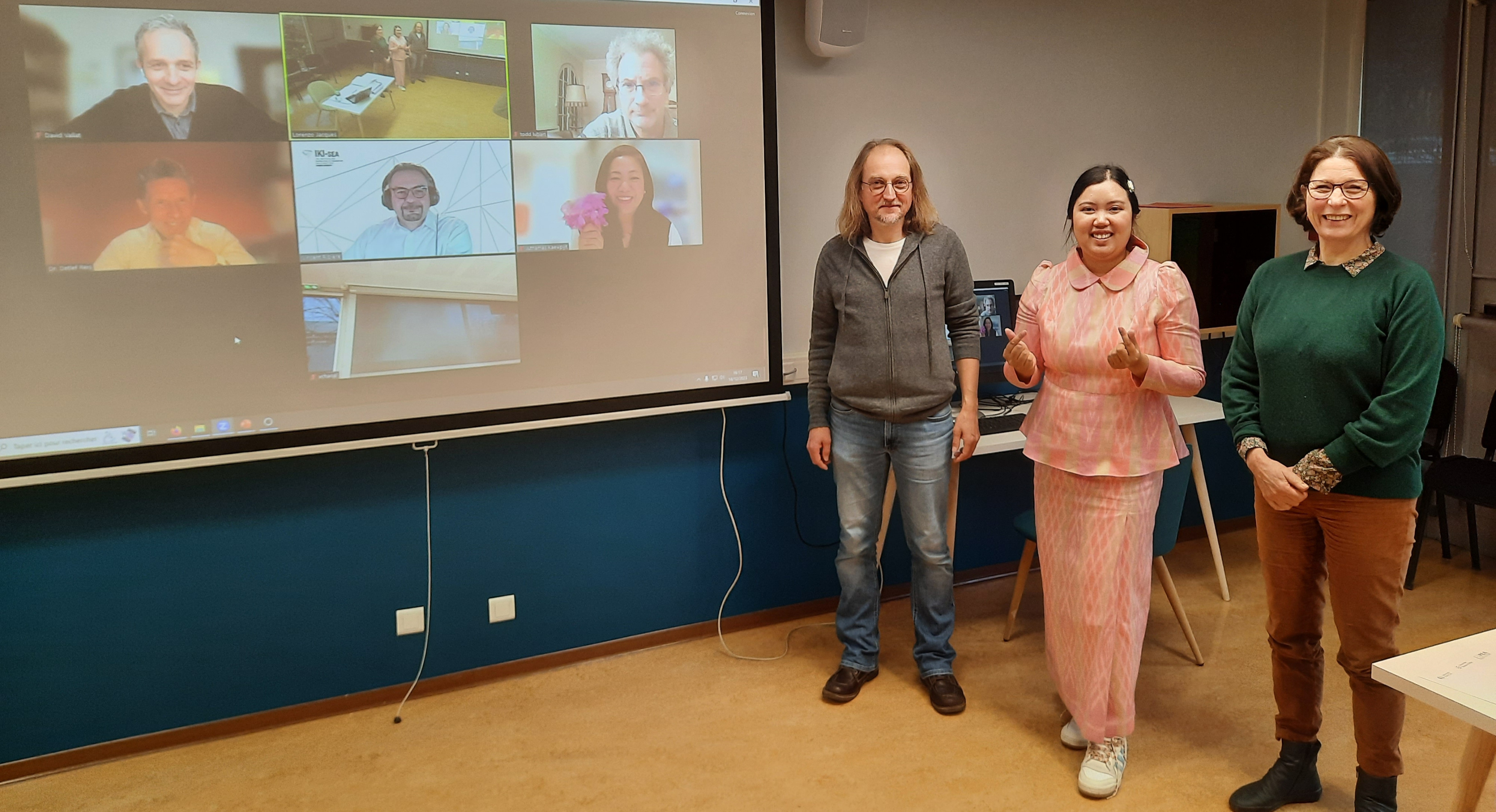
Exploring the Concept and Practice of Team Creativity Through the Critical Incidents Approach
Jury Membership
| Valérie CHANAL | Université Grenoble Alpes | Thesis Advisor |
| Vincent RIBIERE | Bangkok University | Thesis Co-Advisor |
| Juthamas KAEWPIJIT | National Institute of Development Administration | Examiner |
| Todd LUBART | Paris Descartes University | Rapporteur |
| David VALLAT | Sciences Po Lyon | Rapporteur |
| Nicolas LESCA | Université Grenoble Alpes | Examiner |
| Detlef REIS | Bangkok University | Guest |
Abstract
Team creativity has become a key driver of business success in today's competitive landscape. A team's ability to collaborate creatively, generate innovative ideas, and solve complex problems is of paramount importance. This study conducted a systematic literature review, examining 193 selected references to explore the dimensions and key factors that define team creativity. Using the Input-Mediator-Output (IMO) framework of team effectiveness (Matthieu, 2008), we categorized 274 factors of team creativity from these references. We developed a comprehensive taxonomy, the "Team Creativity IMOT model (TCIM)," to enhance our understanding of team creativity. Our survey also highlighted a gap in research methodologies. Quantitative surveys predominated, accounting for 145 of the 193 studies on team creativity. This predominance underscored a lack of qualitative research and practical insights, particularly regarding contextual and real-world factors. To address this gap, we interviewed 33 team leaders from various sectors to identify the key factors of team creativity. These factors were compared to the TCIM (Team Creativity and Innovation Model) developed in our literature review, resulting in two themes: Theme 1, which addresses factors that enhance team creativity, and Theme 2, which addresses factors that hinder it. Our results showed that elements such as team composition, creative processes, motivation, leadership, and psychological safety were considered essential by team leaders for improving team creativity. Conversely, factors beyond the team's control, poor leadership, the absence of a creative process, an unfavorable team composition, and contextual constraints specific to Thailand were considered obstacles to team creativity. Our results also revealed variations in these factors across sectors, whether creative or not. However, the TCIM did not provide a detailed understanding of the team creative process within a specific context. Therefore, we conducted in-depth interviews using the Critical Incident Technique (CIT) to identify critical events in both successful and unsuccessful creative projects. This CIT approach is underutilized in team creativity research but was chosen to examine context-specific creativity processes. In summary, the TCIM provides a valuable framework for future team creativity research, allowing for the exploration of complex factors and their impact on team creativity. Critical incident analysis offers deeper contextual insights. Future research could focus on developing guidelines to maximize the creative potential of teams. This would enable organizations to better understand the key factors and specific contexts that foster team creativity, thereby promoting overall success.
Date
14H
Location
CERAG - Ground Floor Room
, 150 rue de la Chimie,
, 38400 Saint-Martin-d'Hères
- Share
- Partager sur Facebook
- Partager sur LinkedIn