
- Share
- Partager sur Facebook
- Partager sur LinkedIn
Defense
28, May 2026
CERAG
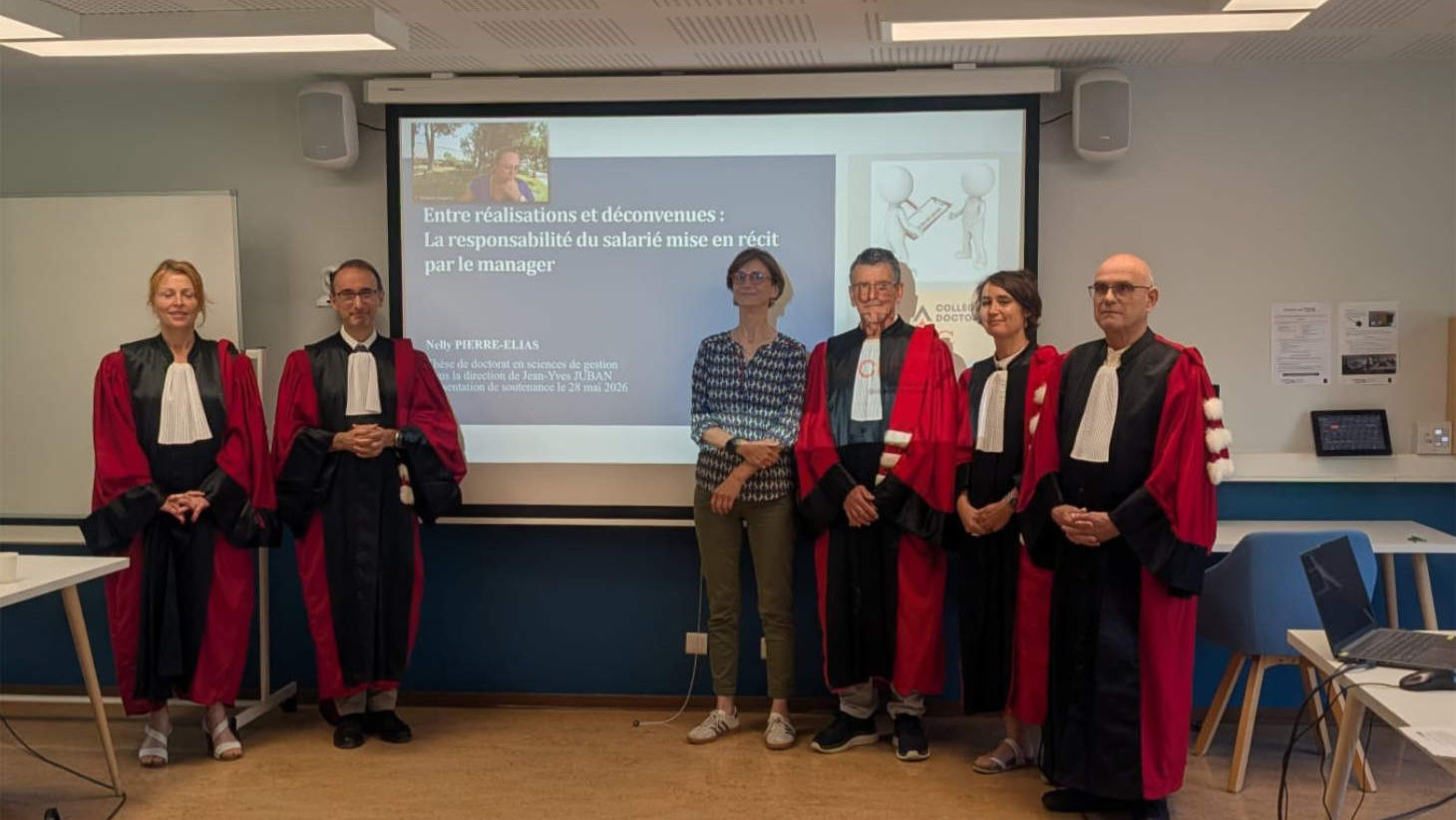
Individual Responsibility Within a Work Group: Can a company, through its organizational structure and management practices, create an environment conducive to the expression of individual responsibility?
Jury
|
Jean-Yves JUBAN |
Université Grenoble Alpes |
Thesis Advising |
| Christian DEFELIX | Université Grenoble Alpes - Grenoble IAE | Examiner |
|
Yvon PESQUEUX |
CNAM |
Rapporteur |
|
Bénédicte BERTHE |
University of Southern Brittany - IAE Southern Brittany |
Rapporteur |
|
Christelle MARTIN-LACROUX |
Université Grenoble Alpes |
Examiner |
| Florence NOGUERA | Paul-Valéry University of Montpellier | Examiner |
Abstract
This dissertation explores the complex concept of individual responsibility in the workplace. Organizations constantly invoke the notion of “employee empowerment” as a means of promoting efficiency and well-being at work, while acknowledging that its implementation remains poorly defined and its outcomes uncertain. Managers are expected to play a central role in this process, yet it is unclear exactly how they perceive individual responsibility in their day-to-day work. The dissertation thus poses the central question: How do managers perceive employee responsibility in work situations? Based on the premise that responsibility is far more an interpretation of action than a concept of controlled autonomy, the research aims to explore how managers interpret employee actions in contexts of success or failure to better identify the factors that explain employee behavior. A qualitative methodology using multiple case studies was adopted. Interviews were conducted with 19 managers from a variety of work organizations. Each respondent described two types of situations: a situation of successful accountability (success) and a situation of unsuccessful accountability (failure). The analysis is based on abductive reasoning utilizing Schlenker’s “Triangle of Accountability.” This model reconstructs the essence of an action—assessed for the purpose of determining responsibility—around three components: identity (I), prescriptions (P), and the event to be accomplished (E)—and helps verify the congruence of information linking each of these components. Four main findings emerge: The manager implicitly employs a structured framework corresponding to the three components of the triangle (I, E, P) to describe a situation involving responsibility. The manager implements targeted action strategies aimed at strengthening each of the three links: skill development and role clarification (I-P link), granting control over the event (I-E link), and establishing and internalizing rules and criteria (E-P link) to foster the conditions for success. The manager offers excusing explanations and seeks to understand the employee’s behavior, but often struggles to determine the individual’s genuine intention to succeed, which limits the quality of the assessment of the failure. Remediation involves the manager retrospectively redefining the components of the responsibility triangle, but its practical application remains uncertain. Ultimately, the research proposes a “concrete definition” of responsibility, offering managers an operational framework to transform accountability into a lever for recognition and effectiveness.
Date
9h00
Location
CERAG
- Share
- Partager sur Facebook
- Partager sur LinkedIn