
- Share
- Partager sur Facebook
- Partager sur LinkedIn
Defense
9, July 2026
Grenoble - Downtown
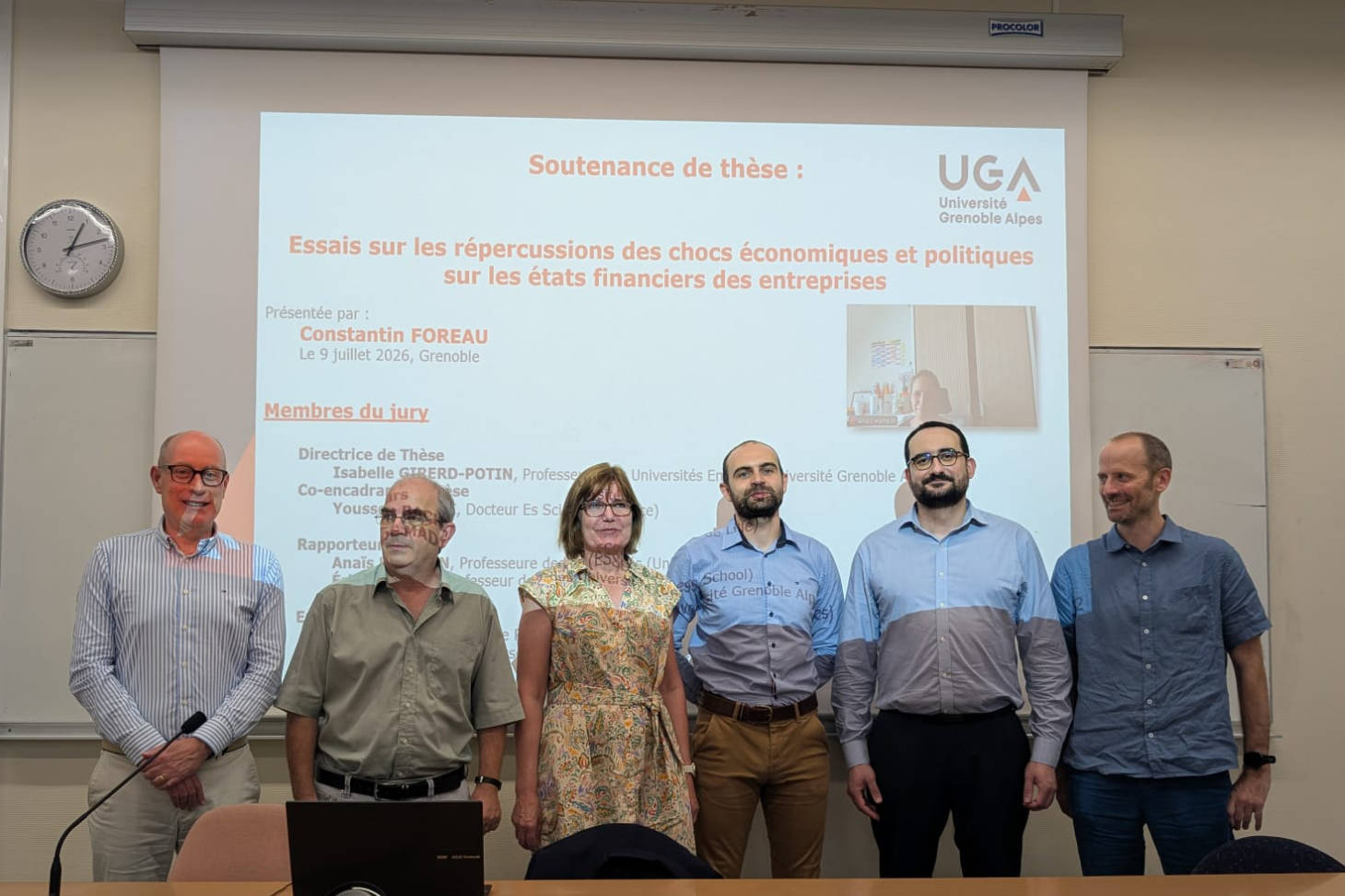
Studies on the Impact of Economic and Political Shocks on Corporate Financial Statements
Jury
|
Isabelle GIRERD-POTIN |
Université Grenoble Alpes |
Thesis Advising |
| Anaïs HAMELIN | University of Strasbourg | Rapporteur |
|
Eric SEVERIN |
University of Lille |
Rapporteur |
|
Laurent Bach |
ESSEC Business School |
Examiner |
| Philippe MADIES | Université Grenoble Alpes | Examiner |
| Youssef KHOALI | Coface | Guest |
Abstract
The COVID-19 pandemic in 2020 severely disrupted the global economy and forced widespread reorganization of businesses. To address the COVID-19 crisis, most governments implemented business support measures. The French State-Guaranteed Loan (PGE) program studied here aims to prevent business failures by ensuring liquidity for companies that were solvent before the crisis. The recovery of economic activity following the COVID-19 crisis, and then the escalation of the Russia-Ukraine war, triggered significant inflation in the prices of raw materials and energy products. This research analyzes how the costs of raw material inputs were passed on by companies. This thesis aims to analyze the impact of economic and political shocks during crises on the financial statements of companies in France. Through original datasets, we study various shocks since 2020 and their impacts on companies' value-added margins, liquidity, debt, and default risk. In the first article, we examine the effects of government-guaranteed loans (PGEs) during the crisis. Our results highlight that companies that received a PGE had higher debt levels, more liquidity, and a greater risk of bankruptcy before the crisis. The results obtained using the difference-in-differences method reveal that companies receiving PGEs increased their debt and liquidity more during the crisis than others. Our work shows that despite an observed decrease in bankruptcies during the COVID-19 crisis, companies have a higher risk of bankruptcy than before the crisis, and that those that took out a PGE have a greater risk of bankruptcy than others. In the second article, we examine the effects of PGEs after the COVID-19 crisis using the difference-in-differences method. Our work shows that at the end of the crisis, companies receiving PGEs have more short-term debt to repay than companies that did not receive them, but are no more liquid than non-recipients, raising questions about their solvency. Companies benefiting from government-guaranteed loans (PGEs) were twice as likely to default between 2020 and 2025. The existing scores fail to capture a significant increase in default risk. Given this inability of the scores to capture default risk, we have updated the Altman score and propose a revised score that incorporates the penalty associated with PGE risk. In a third article, we analyze how companies pass on input costs during periods of high inflation, through changes in the value-added-to-net-revenue ratio. Using linear panel regression, we demonstrate that inflation in the prices of agricultural products, metals, and energy in 2021 and 2022 had a significant impact on the value-added margin. Our analysis shows that companies better positioned to pass on cost increases exhibit lower revenue growth, a higher export share, higher profitability, higher productivity, higher debt, higher liquidity, and a larger share of intangible assets. We demonstrate that sectoral responses vary. Some companies manage to pass on certain increases excessively, thereby increasing their margins, as is the case in the food and beverage sector. This thesis was carried out as part of a project for the credit insurance company Coface under a CIFRE contract with the Université Grenoble Alpes Our work aims to help policymakers, institutions, businesses and other stakeholders better understand the implications of government-guaranteed loans for businesses during and after the COVID-19 crisis, and the implications of passing on raw material costs during periods of inflation.
Date
10h30
Location
Grenoble - Downtown
Gosse Amphitheater, Grenoble INP - Viallet, 46 Avenue Félix Viallet, 38000 Grenoble
- Share
- Partager sur Facebook
- Partager sur LinkedIn