
- Imprimer
- Partager
- Partager sur Facebook
- Partager sur LinkedIn
Soutenance
Le 23 novembre 2026
CERAG
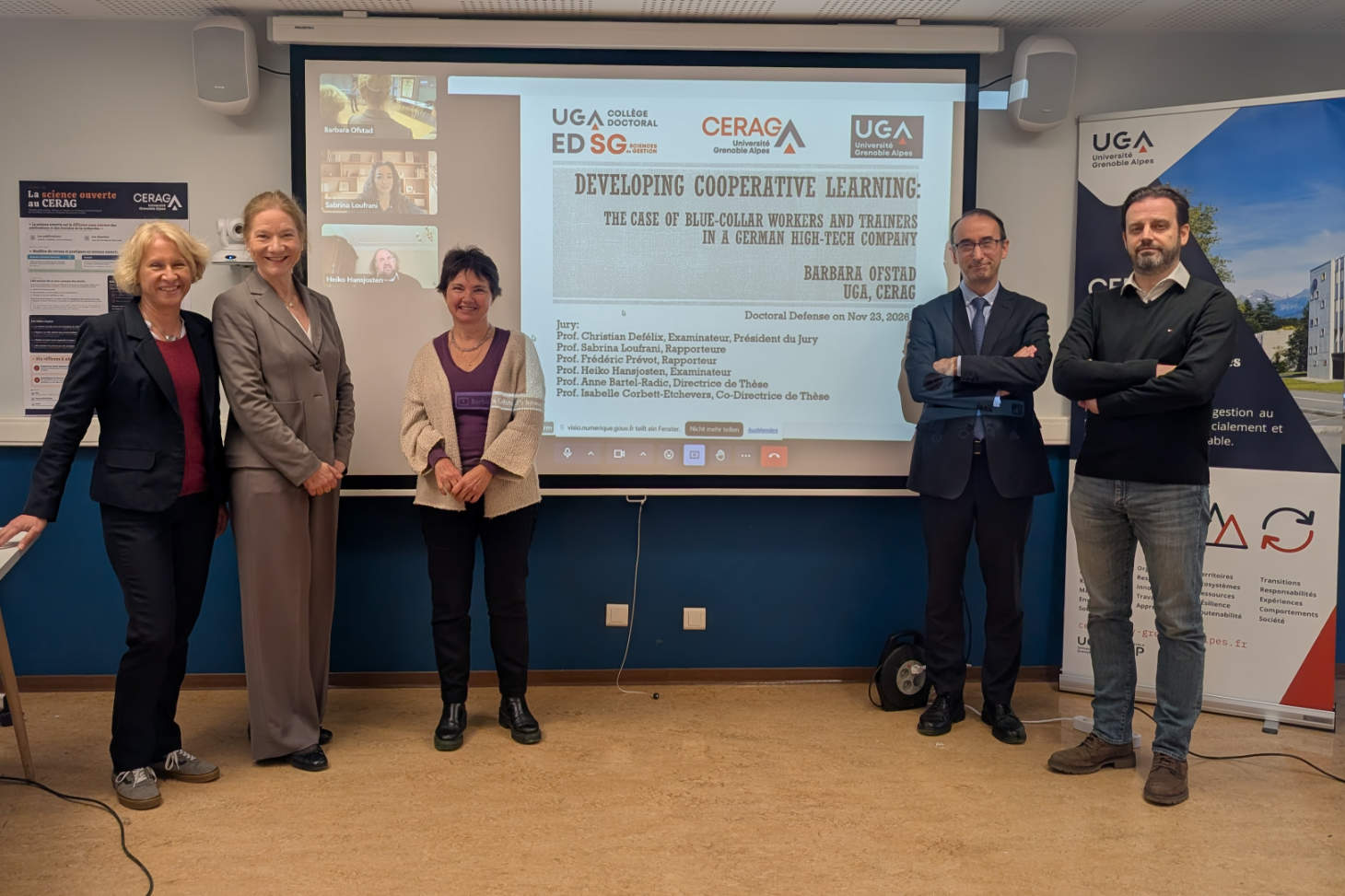
Developing cooperative learning: the case of blue-collar workers and trainers in a German high-tech company
Jury
|
Anne BARTEL-RADIC |
Sciences Po Grenoble - UGA |
Direction de thèse |
| Isabelle CORBETT-ETCHEVERS | Université Savoie Mont Blanc | Co-Direction de thèse |
| Sabrina LOUFRANI | Université Côte d'Azur | Rapporteure |
| Frédéric PRÉVOT | KEDGE Business School | Rapporteur |
| Christian DEFÉLIX | Grenoble IAE-INP, Université Grenoble Alpes | Examinateur |
|
Heiko HANSJOSTEN |
Fachhochschule Heilbronn |
Examinateur |
Abstract
In light of rapid technological and societal changes, it is essential for HR strategies to prioritise employability and organizational resilience through lifelong learning and the development of transferable skills. The aim of this doctoral research is to answer the overarching question of how to develop cooperative learning among blue-collar workers and trainers, which is explored in four articles. The research is based on a unique case study involving corporate trainers and blue-collar workers. An interpretive paradigm is adopted, incorporating elements of ethnography and action research, and using both qualitative and quantitative data. The research question is divided into three sub-questions: Which factors facilitate the uptake of new skills by in-company trainers? Which factors enhance the cooperative learning of trainers? And how does training satisfaction relate to an increase in skills, behavioral change, and higher performance among blue-collar workers? Two inductively grounded models support the key finding that cooperative learning is influenced by individual and social factors, notably the 'boundary-spanning propensity', defined as an individual’s belief in and willingness to cross internal boundaries. Open, people-oriented, use-case-driven learning activities, moderated by leadership and culture, play a pivotal role in adult corporate learning. This thesis demonstrates that behavioral changes are essential for knowledge transfer, emphasizing the importance of incorporating training evaluation into the design of interventions from the outset. The thesis makes theoretical contributions and offers practical recommendations for learning management. The thesis's coined 5A approach — anchor, assess, align, ally and advocate — provides future cooperative training designers and corporate managers with practical advice.
Date
9h30
Localisation
CERAG
- Imprimer
- Partager
- Partager sur Facebook
- Partager sur LinkedIn